Explainer
Why the Comfort Panel watch table rejects your S7-1500 tags
Short answer
The Watch table object is a runtime editor for absolute S7 addresses, not a tag-bound control, and its documented support covers the S7-300/400 families only, so an S7-1515 never appears on its list. Build the monitor screen from HMI tags in I/O fields instead, or display the CPU's web server watch tables in the panel browser.
On this page
The Watch table object on a Comfort Panel has no tag-entry property to find, and with an S7-1515 behind the connection it will not serve values at runtime either. The object is an editor in which an operator types absolute S7 addresses at the machine, and its documented controller support ends with the S7-300/400 families. Your CPU sits outside that list, which is why the editor lets you place the object but offers nowhere to feed it tags. For an S7-1500 project, the dependable monitor screen is built from configured HMI tags bound to I/O fields; the CPU web server covers the deeper diagnostics.
What the Watch table object actually is #
The installed help describes the object as an editor for processing single address areas of a SIMATIC S7 in runtime. Two things follow from that. First, there is no engineering-time tag list: the operator fills the table at the machine by entering addresses directly, a memory bit here, a data word there. Second, the properties you set as the engineer only shape that runtime editor — under "Properties > Properties > Display", in the "Settings" area, you choose the control elements available in runtime. Searching the property inspector for a tag-entry field is a dead end by design, not a setting you missed. The object was never driven by HMI tags, even on the controllers it does serve.
The supported-controller list is the decision #
Editor availability and runtime support are different facts. The screen-object palette follows the panel family, so a Comfort Panel offers the object in general, while what the object can serve at runtime is decided by the controller family on the connection. The documented support for this object covers the S7-300/400 families only, and the family your CPU belongs to is not on that list, so addresses typed into the runtime table cannot be served. Do not spend an evening debugging entries: on this project, treat the object as unavailable and build the replacement screen described below.
This is the same pattern as other pairing questions around Comfort Panels, where the documented support of the specific object or service decides rather than what the editor lets you place, as in configuring a TP900 Comfort panel with a CPU 412-5H project. The HMI connection itself is not the problem: Siemens documents the connection options for S7-1500 and S7-1200 CPUs, and ordinary HMI tags and I/O fields run over that connection without difficulty.
Worked example: replacing the watch table with a six-variable monitor screen #
Inputs, with their sources
- Panel and CPU: a Comfort Panel on an S7-1515 — the combination in question.
- Object behavior: a runtime editor for single S7 address areas; engineering settings limited to the runtime control elements — the object's help.
- Supported controllers: the S7-300/400 families — the same help; configured family: S7-1500.
- Example monitor list, an illustration for the arithmetic: 4 REAL values at 32 bits each and 2 INT values at 16 bits each.
Rule in words: the object is usable only when the configured controller family stands on its supported list; otherwise every variable on the list becomes one HMI tag, shown in one I/O field with one label per row.
Arithmetic
- Supported-list match: families on the list, 2; configured family found among them: 0 of 2 — the object is out.
- Screen objects: 6 variables × (1 label + 1 I/O field) = 12 objects.
- Process data per acquisition pass: 4 × 4 bytes + 2 × 2 bytes = 16 bytes + 4 bytes = 20 bytes, before protocol overhead.
Result: one screen with 12 objects, whose tags move 20 bytes of process data per pass — a load the connection carries without noticing.
Decision: for these six variables, build the screen by hand and keep every field display-only. Above roughly a dozen variables, stop typing tags one by one and bring them across from the PLC tag table instead, as covered in importing a PLC tag CSV into an existing HMI tag database. Enable writing only on the few fields an operator must actually change.
Building the screen from HMI tags and I/O fields #
The replacement is an ordinary configured monitoring page, and each step is standard engineering:
- Create one HMI tag per variable on the connection to the CPU, and check that each tag's PLC reference and data type match the controller variable — read the actual reference, not a similar tag name.
- Lay out one row per tag: a label naming the process value in the operator's terms, and an I/O field bound to the tag, formatted with its unit so nobody reads a raw integer as an engineering quantity.
- Keep monitoring fields display-only. Where an operator must write, choose a variable meant for commands or setpoints; the PLC program can overwrite an HMI-entered internal value on its next execution cycle, which makes writing to it an unreliable control.
- Let values update only while the screen is open, so the tags drop out of the acquisition load when nobody is watching.
- Compile, resolve tag and connection errors, transfer, then compare every field against the online monitor in STEP 7; watch one safely changing test value update, and test any authorized write under controlled machine conditions.
- If a tag's address is refused at compile time, the fault is in the address entry itself, and the fixes in fixing invalid bit address errors when adding HMI tags apply directly.
The CPU web server route for deep diagnostics #
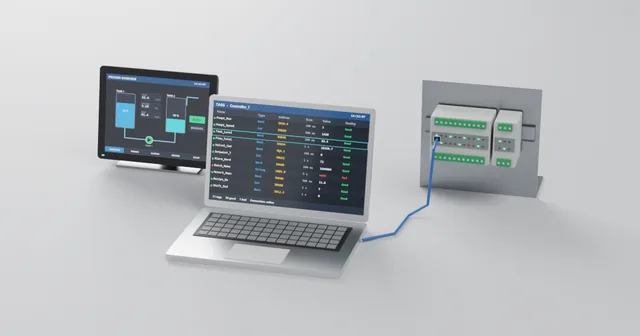
Watch tables configured in STEP 7 can also be displayed in the CPU's web server: you select the desired watch tables in the CPU's web server parameters, and an authorized user reaches them through the CPU's web pages. The panel's browser can open those pages, which gives maintenance real watch tables, independent of the HMI project. This route never feeds the native object; it is a separate diagnostic path over the network, so test it on the actual panel for navigation and readability before promising it to anyone.
One access note belongs here: the web server monitors and administers the CPU through authorized users, and enabling it opens a diagnostic path to the controller over the plant network — assign the user list and access levels deliberately, and keep any write-capable table on maintenance accounts only.
Questions asked
Does the Watch table object work with an S7-1200 instead?
No. The documented support ends with the S7-300 and S7-400 families, so an S7-1200 project is excluded exactly like the S7-1515 case. Build the same I/O-field monitor screen; the HMI connection to an S7-1200 CPU is configured the same way as the one to an S7-1500.
Why can I still place the object on the screen if my CPU is not supported?
The object carries no tag or connection reference at engineering time, so the compiler has nothing to check and the project builds without a warning. The mismatch first shows at runtime, when the table cannot serve the addresses typed into it. Placement proves only that the panel family offers the object, not that your connection can use it.
What if I need watch-table diagnostics only a few times a year?
Then leave it out of the HMI project entirely. Open a configured watch table online from the STEP 7 engineering tool on a laptop at the cabinet, or display selected watch tables through the CPU web server and call them up in the panel browser. Reserve the built screen for the values operators actually watch during daily running.
Will the replacement tags burden the panel or the CPU?
No. The six example tags move 20 bytes of process data per acquisition pass before protocol overhead, which is negligible for this connection. Load scales with the number of tags multiplied by their update rate, so the practical limit is screen readability long before it is the controller.