Explainer
Why an FWX compiled in WinCC Flexible 2008 needs 2008 runtime
Short answer
An FWX compiled by WinCC flexible 2008 runs only on WinCC flexible 2008 Runtime; a 2007 Runtime target will not load it. Save As Version converts the project to the 2007 format but never converts an already-compiled file, so you open the converted project in WinCC flexible 2007, compile it there, and deploy that FWX.
On this page
- The project and the compiled file are different artifacts
- Why the runtime generation is fixed at compile time
- What Save As Version converts, and what it leaves alone
- The decision for each case
- Building the runtime file for 2007 Runtime
- When WinCC flexible 2007 is not on the engineering PC
- Worked example: one project, two runtime generations
- Checks before the transfer
- Questions asked
An FWX compiled in WinCC flexible 2008 runs on WinCC flexible 2008 Runtime and nothing older, so a station with 2007 Runtime will not load it. The way to serve a 2007 Runtime target is to save the project as version 2007 in WinCC flexible 2008, open that converted project in WinCC flexible 2007, and compile it there; the file the 2007 compiler writes is the one the 2007 Runtime loads. The rule behind both cases: the runtime generation of an FWX follows the compiler that produced it. Save As Version converts the editable project and never a file that is already compiled, which is why converting without recompiling changes nothing on the target.
The project and the compiled file are different artifacts #
The project is the editable source: screens, tags, scripts and the panel configuration, opened and changed in the engineering tool. The FWX is what the compiler writes from that source for one runtime generation. Compilation is a translation step, and the translator is the compiler version you run. Build in WinCC flexible 2008 and the output is written for WinCC flexible 2008 Runtime; build in WinCC flexible 2007 and it is written for the 2007 Runtime. An FWX is never edited or converted; it is only replaced by a new compile. So the question of which runtime a file needs has exactly one answer: the version of the compiler that produced it.
Why the runtime generation is fixed at compile time #
WinCC flexible ties its tool chain to the panel versions configured in the project. For 2008, Siemens documented the gating in support entry 21742389: the generator, runtime and simulation start only when the operator panels in the project carry the versions that belong to WinCC flexible 2008. The compiler therefore always writes for its own generation, and each runtime generation loads the files its own compiler wrote. WinCC flexible 2007 Runtime will not start a file the 2008 compiler produced, and transferring that file again does not change the outcome.
What Save As Version converts, and what it leaves alone #
Save As Version is a project operation. It writes a copy of the editable project in the format the older engineering tool reads; without that step, WinCC flexible 2007 refuses the project outright, the failure covered in why WinCC flexible 2007 cannot open a 2008 project. It does not touch compiled output: the FWX built before the conversion remains the 2008 compiler's file, and it still needs 2008 Runtime. Conversion changes the source; compilation produces the runtime file. They are separate operations, and a 2007 target needs both, in that order.
The decision for each case #
| Situation | Runtime that loads the file | What you deploy |
|---|---|---|
| Project compiled in WinCC flexible 2008, target can run 2008 Runtime | WinCC flexible 2008 Runtime | The FWX from the 2008 compile, unchanged |
| Target must stay on 2007 Runtime | WinCC flexible 2007 Runtime | The FWX from compiling the converted project in WinCC flexible 2007 |
| Project converted to 2007 format, then compiled in 2008 again | WinCC flexible 2008 Runtime | A 2008 file again: the saved format does not survive compilation |
| No WinCC flexible 2007 available, target is on 2007 Runtime | None you can produce today | Nothing yet: install 2007 to compile, or move the target to 2008 Runtime |
The third row is the trap. Opening the converted copy in the 2008 tool and building it there writes a 2008-generation file, because the compiler, not the saved format, sets the runtime generation.
Building the runtime file for 2007 Runtime #
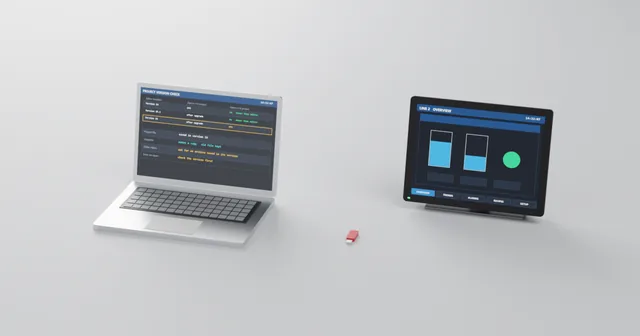
- Open the project in WinCC flexible 2008.
- Save a copy in the 2007 format with Save As Version, and keep the 2008 original untouched as the master.
- Open the converted copy in WinCC flexible 2007.
- Compile it there.
- Transfer the FWX from that 2007 build to the 2007 target. The transfer restarts the station and the operator loses the screen while the new file loads, so download with the machine in a safe state, never mid-cycle.
If the Save As copy fails while the original project still compiles, that failure has its own causes and its own fix; work through why a WinCC Flexible Save As copy fails while the original builds before going further, because everything downstream depends on a clean conversion.
Keep the two build outputs apart. Both files come from the same project and carry its name; only the compiler differs. Label the storage by compiler version, one folder per build for example, so the 2008 file is never carried to a 2007 panel.
When WinCC flexible 2007 is not on the engineering PC #
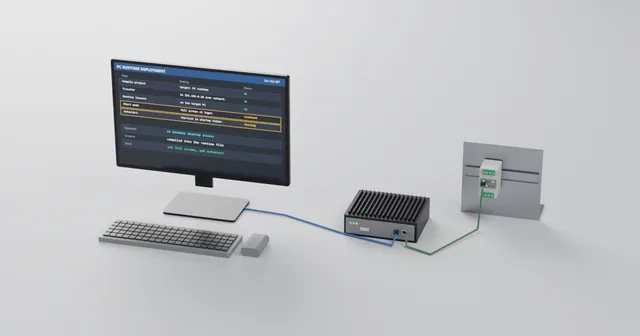
Without the 2007 compiler there is no file you can produce for 2007 Runtime; no converter writes one. Two ways out:
- Install WinCC flexible 2007 on the engineering PC. Before you put it on a machine that also runs TIA Portal V13, read why installing WinCC flexible breaks TIA Portal V13.
- Move the target to 2008 Runtime. On a panel that means updating the image to the 2008 version, because image and engineering versions are matched, the pairing you also meet when updating an MP370 panel image for a WinCC flexible 2007 project. On a PC station it means the 2008 runtime on the workstation, the path covered in running a WinCC flexible 2008 project in PC runtime.
Until one of the two is done, the 2007 stations keep their last 2007-compiled file. Do not transfer the 2008 file to them; it will not start.
Worked example: one project, two runtime generations #
Illustrative case: a packaging line has 5 operator stations configured in one WinCC flexible 2008 project, made up of 4 panels on 2007 images that cannot be updated this production season and 1 PC station where the 2008 runtime is already installed.
- Compile 1, in 2008: 1 FWX for the PC station, so 1 deployment.
- Save As Version 2007: 1 converted copy of the project.
- Compile 2, in 2007: 1 FWX for the panels, so 4 deployments of that same file.
The arithmetic is the check: 5 stations = 1 PC + 4 panels, served by 2 compilations and 2 runtime files. Count 3 files or 6 deployments and a build or a transfer went to the wrong place. The 4 panel downloads each blank a screen during transfer, so they go into one planned window with the line stopped.
Checks before the transfer #
- The compiler version behind the deployed file equals the runtime version of the target: a 2007 build to 2007 Runtime, a 2008 build to 2008 Runtime.
- On a panel, the image version matches that compile version; on a PC, the installed runtime version does.
- The file is the output of the last compile after the conversion, sitting in the 2007 build's storage, not the 2008 one.
- After the transfer, the station restarts into the converted project and the screens changed in this round are present.
The rule to carry away: the runtime generation of an FWX is decided by the compiler that built it. Match compiler to runtime, 2008 to 2008 and 2007 to 2007, and let Save As Version do only its own job, which is the project.
Questions asked
Can the 2008 compiler build a file for 2007 Runtime from the converted project?
No. The runtime generation of an FWX follows the compiler that built it, not the format the project was saved in. A project saved as version 2007 and then compiled in WinCC flexible 2008 still yields a file for 2008 Runtime. Only a compile in WinCC flexible 2007 writes a file the 2007 Runtime loads, so the converted project must be opened and built with the 2007 tool.
Which copy do I keep as the master project?
Keep the WinCC flexible 2008 project as the master and treat the version-2007 copy as a build input. Make every change once in 2008, then convert and recompile for the 2007 stations. If you edit both copies separately they drift apart within a few changes, and a later conversion from the master will not carry edits made only in the 2007 copy.
Can I test the converted project with the 2008 simulator before compiling in 2007?
Not reliably. In WinCC flexible 2008 the generator, runtime and simulation start only when the project's operator panel versions are set for 2008, and the converted project carries the 2007 panel versions. Simulate the converted project with the 2007 engineering tool instead, or test the 2007-compiled file on a bench panel with a 2007 image before the production transfer.